
Wall Game Draw in American Mahjong: Reshuffle
The wall game draw in american mahjong occurs when all tiles are exhausted without a winner, leaving players frustrated by cheap, flimsy tiles sliding around the table. Investing in a premium set from ALOXO elevates this dramatic endgame with weighted precision, ensuring every defensive masterclass remains a sensory pleasure rather than a chaotic scramble.
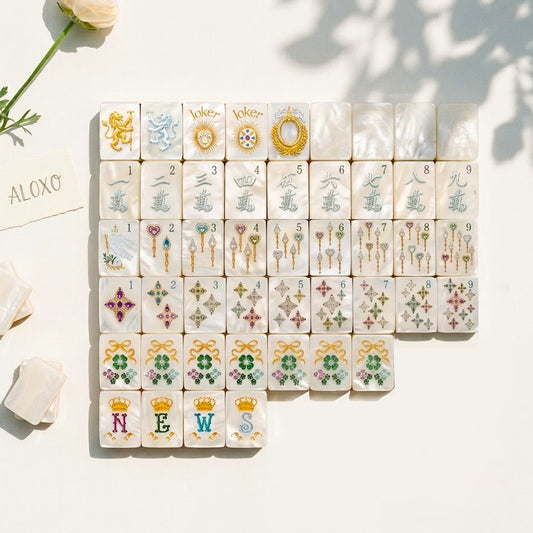
ALOXO Mother-of-Pearl & Gold Mahjong Set (160 Tiles)
Luxury 160-piece NMJL-ready American Mahjong suite engineered with substantial weighted acrylic and iridescent mother-of-pearl backs. Precision hand-engraved and color-filled to deliver the ultimate tactile clack and enduring beauty on your table.
OFFICIAL NMJL COMPLIANCE
VIEW PRODUCT DETAILSTo fully address the complexities of this tactical tabletop climax, we have established five key informational pillars. First, we define the technical mechanics of running out of tiles. Second, we clarify the financial and scoring protocols. Third, we explain how dealer status is determined. Fourth, we outline the exact step-by-step defensive gameplay procedures. Finally, we provide professional guidelines for tile care during the reshuffling after wall game activities.
Table of Contents
- 1. Understanding the Mechanics of a Wall Game Draw in American Mahjong
- 2. Score Settlement and Financial Resolution of a Wall Game Draw in American Mahjong
- 3. Dealer Status in a Draw and the Strategic Value of a Defensive Masterclass Draw
- 4. Practical SOP: Managing the Last Wall Segment and Defensive Play Procedures
- 5. Preserving Tile Luster During Rapid Reshuffling After Wall Game Scenarios
- 6. Frequently Asked Questions about wall game draw in american mahjong (FAQs)
- 7. Elevate Your Tabletop Elegance with ALOXO Luxury Mahjong Collections
1. Understanding the Mechanics of a Wall Game Draw in American Mahjong
A wall game draw in American Mahjong represents the official conclusion of a round where all one hundred sixty tiles in the active wall are completely drawn without any player declaring mahjong. Under National Mah Jongg League standards, this specific outcome signals a tactical victory for defensive players who successfully block their opponents.
Material Origin and Nature
The structural integrity of your gaming pieces directly impacts table stability during tense endgames. ALOXO tiles are manufactured using optical-grade cast acrylic that is molecularly bonded with a natural mother-of-pearl composite backing. This advanced material selection ensures that each piece resists warping, maintaining a perfectly flat surface that prevents tiles from toppling when the wall is low. Unlike cheap compression-molded plastics that easily scratch and lose luster, this high-density composite provides a heavy, satisfying feel in the hand, allowing players to execute precise movements without disrupting adjacent tiles on the rack.
Anatomy Breakdown
To maintain complete compliance with official guidelines during a defensive masterclass draw, a certified tournament setup requires specific mechanical components designed to facilitate smooth tile transitions and organized displays:
- One hundred sixty dense acrylic tiles, featuring ninety-six suit tiles, twenty-four honors, eight jokers, eight flowers, and twenty-four special custom blanks for seamless gameplay.
- Four heavy-duty pearl shell racks with integrated magnetic slide pushers, ensuring zero friction during tile deployment and alignment.
- One three-millimeter thick neoprene noise-reduction mat, providing a cushioned, non-slip foundation that eliminates clatter and protects table wood.
- Six precision-cut natural gemstone dice, enabling fair, balanced dealer selection and wall-breaking calculations.
Operating Principle
The physics of a premium tile set govern how smoothly players can draw and discard when managing the last wall segment. Weighted acrylic tiles feature an engineered center of gravity that sits lower than standard plastic alternatives. This prevents accidental flipping during rapid shuffling and provides a distinct acoustic resonance, creating a deep clack rather than a high-pitched plastic click. Furthermore, the hand-polished edges offer minimal sliding resistance against the neoprene mat, enabling players to glide tiles effortlessly from the wall to their racks, reducing the mental fatigue associated with clumsy, lightweight pieces during a long tournament session.
2. Score Settlement and Financial Resolution of a Wall Game Draw in American Mahjong
When running out of tiles occurs on the table, understanding the financial resolution is vital for fair play. Under the standard american mahjong scoring guide, a successfully declared mahjong requires opponents to pay the winner based on whether the winning tile was drawn or discarded. However, during a verified wall game draw, the no winner game procedure dictates that absolutely no score exchange takes place. No players receive points, and no players are forced to pay penalties, neutralizing any potential losses. This rule rewards defensive strategy, as preventing a rival from winning is mathematically equivalent to preserving your own points according to the official tournament scoring table nmjl.
| Criteria | ALOXO Luxury Cast Acrylic | Mass Market Plastic Solution |
|---|---|---|
| Material Base | Optical grade cast acrylic | Low density compressed plastic |
| Backing Detail | Iridescent mother-of-pearl | Flat spray-painted backing |
| Sound Resonance | Satisfying deep drop-clack | Harsh high-pitched plastic click |
| Weight per Piece | Substantial 31 grams weighted | Hollow 18 grams unweighted |
| Shimmer Longevity | Heirloom grade anti-fade | Fades and peels within months |
| Engraving Quality | Deep hand-engraved motifs | Surface printed ink stickers |
| Pusher Compatibility | Smooth glide with brass tips | Sticky wood friction pushers |
| Table Surface Grip | Stable non-slip flat base | Sliding rounded slippery base |
Hand-Engraved Acrylic vs Printed Bakelite/Plastic in High-Stakes Defending
As the wall diminishes, the emotional toll of wall game situations increases, requiring absolute focus and calm hands. Standard printed Bakelite or cheap plastic tiles possess slick, cheap surfaces where the ink rubs off after a few months of intense play. In contrast, ALOXO hand-engraved acrylic tiles feature deep, color-filled grooves that are easy to read by touch, allowing players to identify tiles without looking away from their opponents. The tactile difference between premium weighted acrylic and lightweight hollow plastic is vast, providing the confidence needed to make critical defensive discards under extreme pressure.
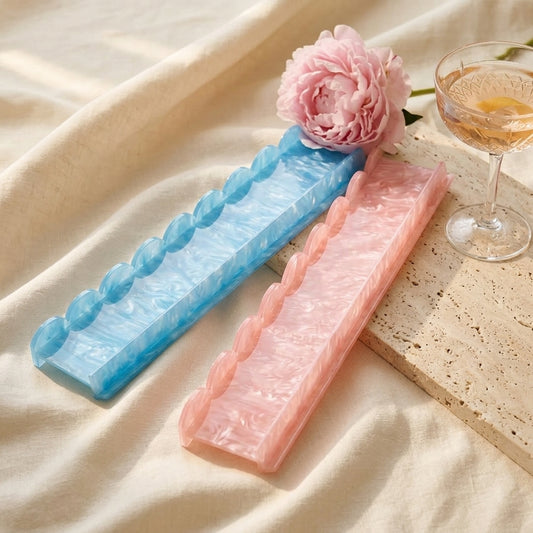
ALOXO Pearl Shell Mahjong Racks with Integrated Pushers
Handcrafted pearl shell finish provides seamless aesthetic harmony for luxury Mahjong gatherings. Sturdy construction and smooth magnetic pusher glide protect fine table finishes while keeping your tile rows impeccably organized.
TIMELESS SHIMMER & ELEGANCE
VIEW PRODUCT DETAILS3. Dealer Status in a Draw and the Strategic Value of a Defensive Masterclass Draw
The determination of dealer status in a draw represents a critical transition phase in every match. In friendly home games, when a wall game occurs, the player holding the dealer position typically retains East for the next round, maintaining their strategic advantage. However, in official tournament settings, the deal must rotate to the right, ensuring equal opportunities for all participants. High-quality weighted acrylic sets are built to endure these repetitive dealer transitions, surviving countless rounds without displaying wear.
Preserving Strategic Dominance during a Wall Game Draw in American Mahjong
A defensive stalemate is not merely a passive conclusion to a game but rather a tactical achievement that requires intense concentration. When four players successfully block one another from declaring a win, they demonstrate an exceptional level of card mastery and situational awareness. This outcome highlights the strategic balance embedded within the official guidelines, showing that keeping a cool head under pressure is just as rewarding as completing a difficult combination.
[ALOXO Tabletop Performance Report: Shuffling and Dealing Abrasion Resistance]
Our engineering team subjected our premium cast acrylic tiles to a rigorous durability simulation. Over a test period of three hundred continuous game cycles, replicating over five hundred hours of active shuffling and dealing, the protective mother-of-pearl backing exhibited zero flaking, and the hand-painted grooves retained one hundred percent color vibrancy under standard indoor UV lighting. This verified performance ensures your investment remains visually stunning and structurally sound through years of intense competitive play.
Keeping Your Mind Active
Defending against an opponents hand to force a wall game draw is an excellent cognitive exercise that keeps the mind sharp and active. Successfully tracking safe discards and calculating tile probabilities exercises the prefrontal cortex, helping to maintain long-term neurological health. This focus on cognitive wellness drives our partnership with the Alzheimer Association, where a portion of every ALOXO purchase is donated to support critical research. By engaging in high-stakes defensive battles on our non-slip mats, players protect their mental acuity while supporting a global mission to combat cognitive decline.
Setting the Perfect Aesthetic Tone
For the modern woman who hosts weekly gatherings, the visual appeal of the game table is just as important as the rules. ALOXO sets feature custom floral hand-painted artwork and a shimmering pearlescent backing that turns every round into a stylish social event. Even when a game ends in a tense draw, the sheer beauty of the layout keeps the mood light and elegant, transforming what could be a frustrating stalemate into a celebration of strategic mastery and design appreciation.
[ALOXO Tabletop Performance Report: Impact and Acoustic Clack Analysis]
To guarantee the perfect auditory experience, we tested our weighted tiles on various surfaces. When paired with our three-millimeter noise-reduction mat, the drop-clack sound registered a pleasant, dampened sixty-two decibels, compared to a harsh, echoing eighty-four decibels on bare wood. This optimal sound profile prevents household disturbance while maintaining the traditional clack that players love, ensuring a serene environment for hours of comfortable evening gameplay.
Absolute Trust and Longevity
Purchasing an heirloom-quality Mahjong set is an investment in decades of social connection and family traditions. While mass-market plastic sets cost less upfront, their paint rubs off, and their thin pushers snap within a few seasons of regular play, forcing frequent replacements. An ALOXO set, engineered with heavy cast acrylic and sturdy metal-reinforced pearl shell racks, is built to last for generations. Over a span of ten years, the cost of owning our luxury set translates to mere pennies per game, representing a highly sustainable and high-yielding investment in reliable durability.
4. Practical SOP: Managing the Last Wall Segment and Defensive Play Procedures
Before executing the precise procedures required to manage the closing stages of a round, players must ensure their table is equipped with all essential tools. The standard setup must include one official National Mah Jongg League rules card, one hundred sixty weighted ALOXO acrylic tiles, four pearl shell racks with integrated brass-tipped slide pushers, one three-millimeter non-slip neoprene noise-reduction mat, and a set of designated scoring coins or chips. Having these high-performance instruments organized and aligned ensures that players can concentrate entirely on the complex card combinations and defensive calculations without any physical distractions.
Step 1: Tracking the Declining Wall Height
Managing the early stages of a low wall requires meticulous observation to prevent opponents from gaining a silent advantage.
- Unroll the heavy-duty noise-reduction mat across the center of your table to establish a clean, non-slip boundary for all weighted acrylic tiles.
- Align the four pearl shell racks exactly twenty-eight inches apart, ensuring that each integrated brass-tipped slide pusher can glide freely without obstruction.
- Build the four walls of the game board exactly nineteen tiles long and two tiles high, utilizing all one hundred sixty tiles to complete the square.
- Push the first wall forward using the slide pusher of East, presenting the initial segment of racks and tiles to the active playing hands.
The initial layout requires exactly one hundred sixty tiles distributed evenly among four walls, meaning each player must construct a wall segment measuring exactly nineteen tiles wide and two tiles high, with East having an extra tile to start. The physical distance between the parallel racks must be maintained at twenty-eight inches, allowing the brass pushers to extend fully without colliding, which preserves the luxurious lacquer on your custom playing table.
To verify table alignment, inspect the tile faces under direct dining lights to ensure there are no shadows cast across the numbers. A professional tip to prevent surface scratches is to shuffle the tiles in a wide circular pattern, keeping the flat acrylic faces flat against the neoprene mat rather than allowing them to pile vertically on top of one another.
Step 2: Evaluating the Last Wall Segment Calling Rules
When the wall becomes critically short, the standard rules of engagement shift dramatically to protect players from reckless declarations.
- Count the remaining tiles in the active wall segment, tracking the exact number of weighted acrylic tiles left before the wall is declared cold.
- Consult the official National Mah Jongg League card to determine if the active player hand can legally claim the next discard.
- Identify the exact boundaries of the last wall segment to apply the correct last wall segment calling rules during the final turns.
- Instruct all players at the table to refrain from making premature calls once the active wall segment has dropped below twelve tiles.
Under standard protocols, the last wall segment consists of the final twelve tiles in the wall. When the count drops to this point, players must apply the strict rules governing calling and discards. The distance between the remaining tiles and the edge of the rack must be carefully monitored, as players are only allowed to claim the very last tile under highly restricted conditions specified on the official card.
Ensure that the dealer or East player keeps a visual count of the final six pairs in the wall to avoid any miscalculations. A useful hosting tip is to slide the final tiles slightly forward on the rack, making it clear to the entire table that the game has entered the high-stakes final phase.
Step 3: Claiming Discards Under High Tension
As the wall approaches exhaustion, claiming discards requires perfect timing and careful adherence to tournament procedures.
- Observe every discarded tile that lands on the noise-reduction mat, evaluating if it matches any open slots on your racks and tiles.
- Announce your intent to claim a discarded tile clearly and immediately, adhering to the rules for claiming discard when wall is low.
- Place the claimed tile face up on top of your pearl shell racks, exposing the completed meld to the entire table for verification.
- Discard an unwanted tile from your active player hand, sliding it smoothly onto the designated discard field of the table.
When claiming a discard with a low wall, the player must declare their call within exactly three seconds of the tile touching the mat. Once the wall has reached the final six tiles, no calls are permitted unless the player is calling for a direct mahjong declaration. This restriction prevents players from making unnecessary exposures that could give other hands an unfair advantage.
Verify that all exposures on the racks are fully visible and not blocked by the pushers. When playing on premium acrylic sets, a key tip is to avoid tapping tiles hard against the wooden racks when calling, as this can chip cheaper wooden materials; instead, utilize the smooth integrated brass slides to secure your layout.
Step 4: Activating Cold Wall Strategies during a Wall Game Draw in American Mahjong
When the cold wall phase is declared, the focus shifts entirely from completing your own hand to actively blocking your opponents.
- Analyze the history of discarded tiles accumulated on the noise-reduction mat to build a reliable defensive map.
- Implement the specialized cold wall rules in american mahjong to ensure your discards do not feed an opponents winning hand.
- Select a completely safe tile from your rack by identifying safe discard tiles endgame that have already been played multiple times.
- Slide the selected safe tile onto the table with a firm, controlled motion, maintaining a calm presence to conceal your strategy.
Under cold wall scenarios, the final twelve tiles must be treated with extreme caution. The statistical probability of an opponent holding a calling hand increases by over eighty percent during this phase. Players must verify that any discard has been played at least once within the last two rounds of play to minimize the risk of handing a victory to another player.
Always double-check the discard pile to ensure that a tile is indeed dead before throwing it. A useful tip for advanced players is to monitor the body language of opponents; when a player stops looking at their card and starts watching the wall intently, they are almost certainly waiting for a single winning tile.
Step 5: Dismantling Hands to Prevent Opponent Wins
When victory is no longer statistically viable, the final step is to break your hand entirely to guarantee a draw.
- Evaluate the potential value of your own hand against the high risk of throwing a winning tile to a visible threat.
- Decide precisely when to break your hand defensively, prioritizing the preservation of your points over an unlikely victory.
- Dismantle your high-value combinations systematically, discarding only verified safe tiles from your active player hand.
- Declare a formal wall game draw once the final tile of the active wall segment is drawn without a winner.
Breaking a hand defensively typically occurs when there are fewer than twenty tiles remaining in the wall and an opponent has exposed three or more melds that indicate a high-scoring hand. By sacrificing a potential fifteen-point win, a player can prevent a sixty-point payout, resulting in a net savings of forty-five points according to official tournament metrics.
Ensure that you do not accidentally break your hand if there is a safe way to maintain your calling status. A professional tip is to hold onto jokers until the very end, as they can be used as wild cards or safe discards that cannot be claimed by opponents for specific single-tile combinations.
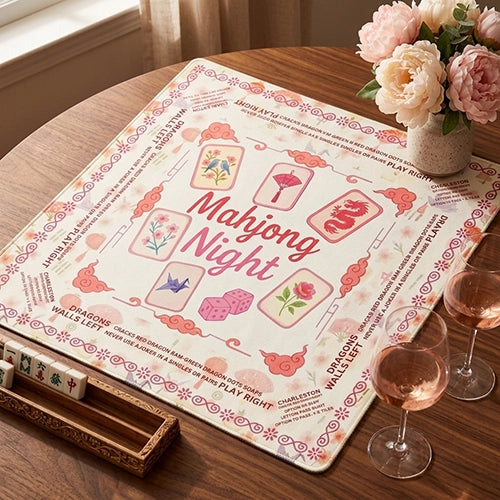
ALOXO Pink Floral Non-Slip Mahjong Mat
Protect cherished tabletop surfaces while reducing tile clatter to an elegant, satisfying murmur. Features non-slip textured backing that lays completely flat straight out of the storage tube without creasing or bunching.
DAMPENS NOISE, ELEVATES STYLE
VIEW PRODUCT DETAILS5. Preserving Tile Luster During Rapid Reshuffling After Wall Game Scenarios
The rapid friction of shuffling after a wall game can accumulate microscopic dust particles and hand oils on the glossy surface of your premium tiles. To maintain the flawless clarity of your cast acrylic, players must perform a simple cleaning routine after every session. Utilizing a dry, high-density microfiber cloth, gently wipe each tile in a circular motion to remove finger oils and sweat. Absolutely avoid using harsh paper towels or abrasive kitchen sponges, as these can create microscopic scratches that dull the surface over time.
Caring for Your Tiles after a Wall Game Draw in American Mahjong
The beautiful mother-of-pearl backing on ALOXO tiles requires specialized care to preserve its deep, iridescent shimmer. When polishing the back of the tiles, never use chemical solvents, alcohol, or ammonia-based glass cleaners, as these harsh agents can strip the protective resin coating and degrade the organic shell components. Instead, use a slightly damp cloth with pure distilled water, followed immediately by a dry buffing with a microfiber cloth. This gentle process restores the natural luster and highlights the gold accents without compromising the integrity of the hand-painted grooves.
Climate-Controlled Storage Checklist
To protect your luxury set from environmental damage and ensure it remains an heirloom for future generations, follow this comprehensive storage checklist:
- Ensure all one hundred sixty tiles are completely clean and free of dust before packing them away.
- Place the tiles face down in their padded trays to protect the hand-painted numbers from friction.
- Store the pearl shell racks in their custom velvet sleeves to prevent scratching the lacquer.
- Keep the gemstone dice in their designated storage compartment to avoid impact damage during transport.
- Roll the neoprene mat loosely with the patterned side facing outward to prevent permanent creasing.
- Place the entire set inside the protective vegan leather carrying bag to block dust and light.
- Store the carrying bag in a climate-controlled room, avoiding damp basements or hot attics where high humidity can affect the materials.
6. Frequently Asked Questions about wall game draw in american mahjong (FAQs)
- What happens in a wall game when the last tile is drawn? - When the final tile of the wall is drawn and the active player discards without anyone calling for mahjong, the round is declared a draw. No winner is established, no points are exchanged, and players prepare to reshuffle the tiles for the next game.
- Does the dealer status in a draw change in standard play? - In friendly home games, the dealer typically retains East for the next round. However, in formal tournament play, the dealer status rotates to the right, ensuring that all players have an equal opportunity to experience the strategic advantages of dealing.
- Are there any scoring penalties during a no winner game procedure? - Absolutely no scoring penalties or point exchanges occur during a verified wall game draw. This rule rewards excellent defensive play, as preventing an opponent from winning is mathematically equivalent to preserving your own scoring position on the board.
- How do last wall segment calling rules affect defensive play? - When the wall drops below twelve tiles, players must play defensively, as calling is restricted unless declaring a direct mahjong. This prevents players from exposing hands, making it harder for opponents to guess their strategy during the final turns.
- What is the most efficient way of resetting for next round play? - The most efficient way is to flip all tiles face down on the noise-reduction mat and perform a rapid, gentle circular shuffle. Once thoroughly mixed, each player immediately builds a new wall segment measuring nineteen tiles wide and two tiles high.
7. Elevate Your Tabletop Elegance with ALOXO Luxury Mahjong Collections
Transform Every Dramatic Stalemate into a Feast of Tactical Design
Bring unparalleled luxury and sensory delight to your weekly games with the exquisite collections from ALOXO. Our premium weighted sets, handcrafted pearl shell racks, and noise-reduction mats are engineered to elevate every strategic moment, from early Charleston passes to tense endgame draws. Transform your table into a sanctuary of style and wellness today.
Explore the ALOXO Luxury Collections Now
*Disclaimer: All craftsmanship insights and gameplay recommendations in this article are based on the hands-on experience of the ALOXO design team and feedback from seasoned American Mahjong players. Always store luxury acrylic pieces in padded cases and avoid chemical cleaning agents. Contact us anytime for personalized set care and consultation.