
Pung vs Kong vs Quint in Mahjong: Tile Counts
pung vs kong vs quint in mahjong defines the core structure of your hand when transitioning from casual gaming to competitive tournament play on an elegant table. By choosing weighted acrylic sets from ALOXO, you ensure your tiles withstand years of shuffling while delivering the perfect auditory clack for every tactical call.
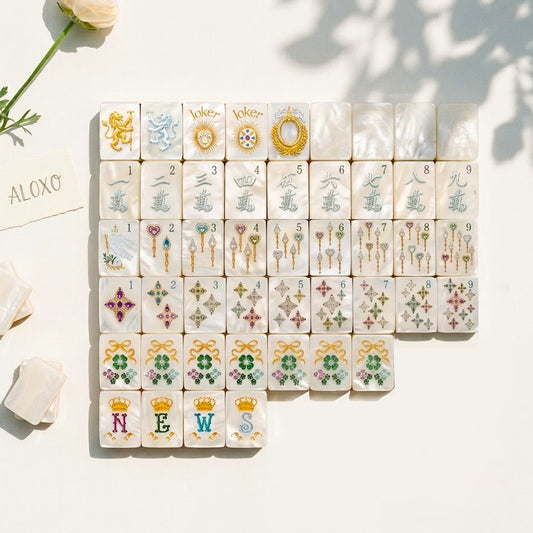
ALOXO Mother-of-Pearl & Gold Mahjong Set (160 Tiles)
Luxury 160-piece NMJL-ready American Mahjong suite engineered with substantial weighted acrylic and iridescent mother-of-pearl backs. Precision hand-engraved and color-filled to deliver the ultimate tactile clack and enduring beauty on your table.
OFFICIAL NMJL COMPLIANCE
VIEW PRODUCT DETAILSTable of Contents
- 1. Comparing Pung vs Kong vs Quint in Mahjong: Tile Count Differences
- 2. How Many Jokers Allowed in a Pung vs Kong vs Quint in Mahjong Set
- 3. Scoring Value Comparison and Difficulty Levels on the National Card
- 4. Strategic Decisions: Expanding a Pung to a Kong During Active Play
- 5. Tabletop Performance: Tactile Sound and Stress Testing Premium Tiles
1. Comparing Pung vs Kong vs Quint in Mahjong: Tile Count Differences
Understanding the fundamental structural differences between a Pung, a Kong, and a Quint is essential for any player aiming to master American Mahjong. These groupings dictate how you construct your hand and determine your path to victory under the official guidelines of the National Mah Jongg League. Each grouping represents a precise combination of identical tiles that must be assembled on your rack. When playing with premium weighted acrylic sets, the tactile satisfaction of organizing these distinct blocks elevates the entire tabletop experience.
Anatomy of Pung vs Kong vs Quint in Mahjong Combinations
A Pung consists of exactly three identical tiles, representing the classic three of a kind. This block is the most common exposure on the table and forms the baseline of many standard hands. Moving up, a Kong requires exactly four identical tiles, which functions as a four of a kind. Finally, a Quint is a specialized grouping of exactly five identical tiles. Because there are only four identical natural tiles of any design in a standard set, completing a Quint absolutely requires the strategic integration of at least one wild card tile.
| Grouping Type | ALOXO Luxury Acrylic Solution | Mass-Market Plastic Solution |
|---|---|---|
| Pung (3 Tiles) | Precision weighted acrylic with 30g density for satisfying placement stability | Lightweight hollow plastic that easily slides out of alignment on the rack |
| Kong (4 Tiles) | Seamless block alignment with crisp hand-painted grooves for clear visibility | Shallow molded impressions where paint easily chips and fades within months |
| Quint (5 Tiles) | Perfect physical alignment on custom pearl shell racks with sleek integrated pushers | Flimsy wooden racks that snag and cause tiles to tip over during play |
| Tactile Feel | Substantial hand feel with polished smooth edges for rapid comfortable sorting | Sharp flashing edges that scratch dining tables and irritate fingertips |
| Acoustic Resonance | Deep solid clacking sound when shuffling on a noise reduction mat | High pitched harsh plastic rattling that disrupts quiet home environments |
| Visual Esthetics | Lustrous mother-of-pearl back design with elegant gold-dusted borders | Plain solid green or white plastic backs devoid of artistic personality |
| Durability Rating | Scratch resistant coating designed to endure thousands of rigorous games | Highly prone to yellowing and surface abrasions after outdoor exposure |
| Set Completeness | 160 tiles fully optimized for NMJL play including extra jokers and flowers | Standard 144 tile setups lacking the mandatory components for American rules |
Integrated Acrylic Pushers vs Wood Racks
When displaying your completed exposures such as a Pung or a Kong, the choice of your tabletop hardware makes a significant difference. Traditional wooden racks often feature metal pins or rough finishes that can scratch your tiles or get stuck during the pushing phase. ALOXO premium pearl shell racks with integrated pushers glide effortlessly across the table. This allows you to expose your tile blocks cleanly and securely, ensuring your focus remains entirely on strategy rather than struggling with unstable equipment.
2. How Many Jokers Allowed in a Pung vs Kong vs Quint in Mahjong Set
A crucial aspect of managing mahjong tile combinations explained on your card is the correct integration of wild cards. Jokers serve as versatile substitutes that can stand in for any suit or value tile to complete a desired block. However, players must adhere to specific rules regarding where and how these wild cards can be placed. Mishandling your wild cards can instantly invalidate your hand, making it dead for the remainder of the round.
Material Origin and Nature of Premium Acrylic
Our premium tiles are crafted from optical-grade cast acrylic bonded seamlessly to a natural mother-of-pearl backing. This high-density material ensures that every single tile, whether it is a natural suit tile or a valuable joker, possesses identical weight and dimensions. This consistency prevents any tactile identification of face-down tiles during the shuffling process, maintaining absolute fairness and integrity at your tournament table.
Anatomy Breakdown of a 160 Tile Set
A complete luxury set from ALOXO includes several critical components designed to support all variations of American play:
- 160 weighted tiles including the standard 152 NMJL setup and 8 custom floral spares
- 8 dedicated custom hand-engraved jokers featuring vivid color fills
- 4 elegant pearl shell racks with integrated magnetic pushers
- 1 set of natural gemstone dice for authentic wind determination
Operating Principles of Jokers inside Pung vs Kong vs Quint in Mahjong Blocks
The rules governing wild cards dictate that you can use any number of jokers in a Pung, Kong, or Quint. In a Pung, you can use up to two jokers to complete the three of a kind. For a Kong, utilizing multiple jokers in a kong rules allows you to substitute up to three wild cards within the four-tile block. In the case of a Quint, since it requires five identical tiles and there are only four natural tiles in existence, you must use at least one joker, and you are permitted to use up to four jokers to complete this highly challenging combination.
ALOXO Pearl Shell Mahjong Racks with Integrated Pushers
Handcrafted pearl shell finish provides seamless aesthetic harmony for luxury Mahjong gatherings. Sturdy construction and smooth magnetic pusher glide protect fine table finishes while keeping your tile rows impeccably organized.
TIMELESS SHIMMER & ELEGANCE
VIEW PRODUCT DETAILS3. Scoring Value Comparison and Difficulty Levels on the National Card
Each season, the National Mah Jongg League releases a new official hands card that shifts the strategic value of different combinations. As you organize your exposed vs concealed hands mahjong choices, you must weigh the difficulty of assembling specific blocks against the points or monetary values they yield. Mastering these values allows you to make split-second decisions on whether to settle for an easier hand or pursue a high-value combination.
Core Specifications of Pung vs Kong vs Quint in Mahjong Layouts
A Pung represents the easiest block to build because it only requires three tiles, making it highly common on the card. A Kong increases the difficulty slightly but remains highly versatile across almost every section of the card. A Quint is vastly more difficult to construct because of its reliance on jokers, which are highly sought after by every player around the table. As a result, sections dedicated to quint hands rules american mahjong offer some of the highest point values on the card.
| Combination Type | Required Tile Count | Relative Card Difficulty | Average Point Value |
|---|---|---|---|
| Pung (Standard Suit) | 3 Identical Tiles | Low | 25 Points |
| Pung (Dragons/Winds) | 3 Identical Tiles | Low to Medium | 25 Points |
| Kong (Standard Suit) | 4 Identical Tiles | Medium | 30 Points |
| Kong (Concealed Only) | 4 Identical Tiles | High | 35 Points |
| Quint (Single Suit) | 5 Identical Tiles (Min 1 Joker) | Very High | 40 Points |
| Quint (Symmetric Dragons) | 5 Identical Tiles (Min 1 Joker) | Extreme | 45 Points |
| Pair (No Jokers Allowed) | 2 Identical Tiles | High (No Wildcards) | Variable on Card |
| Single (No Jokers Allowed) | 1 Unique Tile | High (No Wildcards) | Variable on Card |
| Sextet (Rare Hands) | 6 Identical Tiles (Min 2 Jokers) | Extreme | 50 Points |
| Complete American Hand | 14 Compliant Tiles | Depends on Pattern | Standard Win |
Budget-based Consulting for Casual and Tournament Play
For players who host weekly social gatherings in their homes, a standard luxury acrylic set paired with a durable noise-reduction mat provides the ideal balance of performance and aesthetics. If you are a competitive tournament player who frequently travels to regional matches, investing in a complete tabletop suite with lightweight, protective vegan leather carrying bags and premium gemstone dice ensures you remain organized and stylish on the go. Selecting the right gear tailored to your specific play frequency maximizes both your enjoyment and your long-term value.
Cost-per-Use Formula for Heirloom Acrylic
While mass-market plastic sets seem affordable initially, they frequently suffer from fading paint and warped structures, requiring replacement every few years. Investing in an heirloom-quality ALOXO set, which is engineered to endure decades of active play, reduces your cost per game to mere pennies over its lifespan. This enduring quality makes it not only a beautiful centerpiece for your home but also a highly practical investment that can be proudly passed down to the next generation of players.
4. Strategic Decisions: Expanding a Pung to a Kong During Active Play
A critical skill in competitive play is knowing exactly when to transition your hand from a Pung to a Kong. This decision often occurs in real-time when another player discards a tile you need, or when you draw a fresh tile from the wall. Properly managing these transitions requires a deep understanding of your opponent exposures and a clear view of your active path on the card.
Before beginning your practice sessions, ensure you have all the necessary components arranged on your table. You will need your official card, a complete set of 160 weighted tiles, four pearl shell racks with integrated pushers, and a non-slip noise-reduction mat to protect your table surface and reduce distracting sound.
Step 1: Unroll the Noise Dampening Mat and Align the Pearl Racks
- Unroll your non-slip mat completely across your playing surface, ensuring it lays flat without any creases.
- Place your four pearl shell racks exactly 28 inches apart from each other, forming a perfect square.
- Position the magnetic pushers neatly behind the racks so they do not obstruct your initial tile placement.
- Place your official NMJL card directly in front of your rack for easy hands reference throughout the game.
Ensure your playing area is well-lit so you can read the hand-painted details on each tile face without straining your eyes under dim dining room lights.
Step 2: Shuffle the 160 Weighted Acrylic Tiles Face Down
- Place all 160 weighted tiles face down on the center of your noise dampening mat.
- Use both hands to shuffle the tiles in a circular motion, ensuring thorough mixing for at least 30 seconds.
- Construct four walls of tiles, with each wall measuring exactly two tiles high and nineteen to twenty tiles long.
- Align each wall flush against the front of your pearl racks using the integrated pushers.
To avoid surface abrasions during rapid shuffling, always slide the tiles gently across the felt surface rather than pressing them down aggressively.
Step 3: Deal the Hand and Evaluate the National Card Requirements
- Roll your natural gemstone dice to determine which player will open the wall and distribute the tiles.
- Deal exactly thirteen tiles to each player, with the dealer receiving an extra fourteenth tile to open play.
- Arrange your tiles neatly on your pearl racks, keeping your jokers and potential pairs grouped together.
- Compare your dealt hand against the active sections on your card to identify your primary and secondary target hands.
Inspect the legibility of your tiles under your table lighting to ensure you do not misinterpret a critical suit value during the fast-paced Charleston phase.
Step 4: Execute Strategic Calls for Exposed Tile Blocks
- Monitor the table carefully as opponents discard tiles, listening for potential calls of Pung or Kong.
- If you require a discarded tile to complete a Pung, call the tile clearly before the next player draws.
- Expose the completed Pung block on the top shelf of your pearl rack for all players to see.
- Observe the reactions of your opponents to assess if they are tracking your active exposures.
Utilize the reading opponent exposures mahjong technique to determine if other players are competing for the exact same suit or value tiles.
Step 5: Transition the Pung to a Kong or Quint Block Safely
- When a fourth identical tile is discarded or drawn, evaluate if your card section permits an exposed Kong block.
- If yes, call the tile to expand your existing Pung to a Kong using the calling a tile for kong rules protocol.
- If you are pursuing a high-value Quint, use the calling a tile for quint rules method to integrate a joker into your block.
- Discard an unwanted tile from your hand to maintain your correct tile count of fourteen active tiles.
Remember that you can only call a tile to complete or expand an exposure if the hand you are building is classified as an exposed hand on your card.
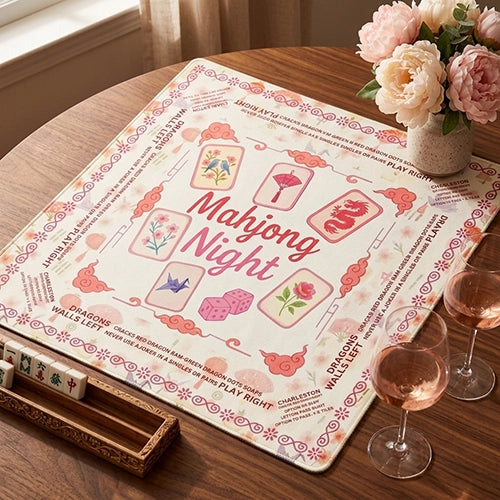
ALOXO Pink Floral Non-Slip Mahjong Mat
Protect cherished tabletop surfaces while reducing tile clatter to an elegant, satisfying murmur. Features non-slip textured backing that lays completely flat straight out of the storage tube without creasing or bunching.
DAMPENS NOISE, ELEVATES STYLE
VIEW PRODUCT DETAILS5. Tabletop Performance: Tactile Sound and Stress Testing Premium Tiles
To qualify as true heirloom-grade products, luxury gaming equipment must undergo rigorous real-world durability testing. Our artisan design team conducts extensive stress trials to ensure every piece performs flawlessly under high-frequency shuffling and intense tournament environments. By combining advanced materials science with traditional hand-finishing techniques, we deliver products that are truly crafted to endure.
Drop and Clack Acoustic Resonance Test
We measure the acoustic performance of our tiles by dropping them from a standard height onto various table surfaces. When shuffled on a premium noise-reduction mat, our weighted acrylic tiles register a deep, satisfying clack that minimizes household disturbance. In contrast, cheap hollow plastic tiles produce a harsh, high-pitched rattle that can cause auditory fatigue during extended multi-hour play sessions.
Abrasion and Scrub Resistance Test
To simulate years of intense tabletop use, our tiles are subjected to thousands of abrasive friction cycles. This testing validates the durability of our protective outer coatings and ensures that the hand-painted, color-filled grooves remain bright and legible. Our cast acrylic formulations resist scratches and scuffs, preserving the beautiful shimmer of the mother-of-pearl backs even after repeated cleanings.
Temperature and Humidity Tolerance
We test our materials under extreme environmental conditions to ensure they maintain structural integrity during outdoor games or poolside gatherings. Whether you are hosting a lively summer afternoon patio match or a cozy winter fireplace tournament, our tiles resist warping and cracking. This exceptional durability earns our collections a top rating under both the official NMJL Guidelines and the rigorous ASTM D790 standards for flexural strength.
Frequently Asked Questions about pung vs kong vs quint in mahjong (FAQs)
- What is the main tile count difference between a Pung and a Kong? A Pung consists of exactly three identical tiles. A Kong expands this block to exactly four identical tiles.
- Can you use multiple Jokers in a Quint hand? Yes. You can use multiple Jokers in a Quint hand to satisfy the five-tile requirement.
- How many tiles are required to declare a Quint? A Quint requires exactly five identical tiles.
- Can a player call a discarded tile to complete a Quint? Yes. A player can call a discarded tile to complete an exposed Quint.
- What standard tile count is required for an American Mahjong set? A standard American Mahjong set contains exactly 160 tiles.
Elevate Your Tabletop Elegance with ALOXO Luxury Mahjong Collections
Begin Your Legacy with Hand-Engraved Masterpieces
Every game night is an opportunity to connect, laugh, and challenge your mind. Our premium collections are meticulously designed to elevate your playing experience, combining exceptional durability with stunning aesthetic design. Discover how a beautifully crafted set can bring joy to your home while keeping your mind sharp and active.
ALOXO Store Luxury Collections
*Disclaimer: All craftsmanship insights and gameplay recommendations in this article are based on the hands-on experience of the ALOXO design team and feedback from seasoned American Mahjong players. Always store luxury acrylic pieces in padded cases and avoid chemical cleaning agents. Contact us anytime for personalized set care and consultation.