
Mahjong Tile Combinations Explained: Full List
mahjong tile combinations explained serves as the absolute structural foundation for players transitioning from basic tile shuffling to competitive National Mah Jongg League mastery. This definitive table design and gameplay guide by ALOXO clarifies every exact grouping, ensuring your upcoming luxury social gathering flows with confidence, sophistication, and flawless tactical execution.
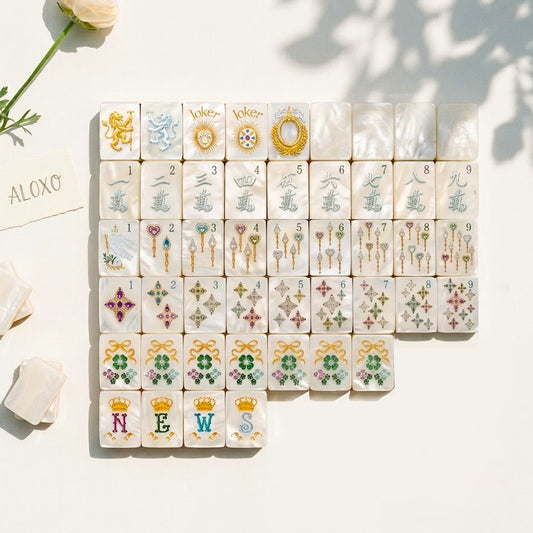
ALOXO Mother-of-Pearl & Gold Mahjong Set (160 Tiles)
Luxury 160-piece NMJL-ready American Mahjong suite engineered with substantial weighted acrylic and iridescent mother-of-pearl backs. Precision hand-engraved and color-filled to deliver the ultimate tactile clack and enduring beauty on your table.
OFFICIAL NMJL COMPLIANCE
VIEW PRODUCT DETAILSTable of Contents
- 1. Quantitative Breakdown of Tile Blocks: Single Tiles, Pairs, Pungs, Kongs, Quints, and Sextets
- 2. Step-by-Step SOP for Creating, Displaying, and Announcing Tile Blocks
- 3. American Mahjong versus Traditional Formats: Terminology and Block Structures
- 4. Architectural Specifications and Selection of a Premium 160-Tile NMJL Set
- 5. Mastering Joker Rules and Preventing Common Table Pitfalls
- 6. Frequently Asked Questions about mahjong tile combinations explained (FAQs)
- 7. Elevate Your Tabletop Elegance with ALOXO Luxury Mahjong Collections
1. Quantitative Breakdown of Tile Blocks: Single Tiles, Pairs, Pungs, Kongs, Quints, and Sextets
Understanding tile combinations is the first milestone toward competitive proficiency. Mastery of these structures prevents illegal exposures, accelerates card reading, and streamlines hand formulation under standard National Mah Jongg League criteria. The exact distribution of tiles dictates your strategic options, making it essential to memorize how each block functions on the active card.
Material Origin and Tactile Identification of Tile Groupings
For players dedicated to the social art of the game, recognizing tile sets is not merely a visual task but a tactile experience. Premium weighted acrylic tiles are manufactured by bonding high-density compound resin with an iridescent mother-of-pearl backing. This structure provides a satisfying weight of 30 grams per tile, allowing players to instantly verify physical groupings by feel during rapid table play. Recognizing the thickness, weight, and smooth engraving helps seasoned hosts execute rapid tile groupings nmjl setups without looking down, creating a seamless and elegant rhythm at the table.
Anatomy Breakdown of the Core Tile Blocks
To establish perfect clarity on the table, every player must understand the exact quantitative makeup of each tile block. The structured hierarchy consists of six distinct classifications:
- Single Tiles: Individual tiles that must match the exact suit and value specified on the card, with zero substitutions allowed.
- Pairs: Two identical tiles of the same suit and value, forming the vital building blocks for consecutive runs and special hands.
- Pungs: Three identical tiles of the same suit and value, which serves as one of the most common combinations in standard play.
- Kongs: Four identical tiles of the same suit and value, establishing strong mid-tier scoring potential across multiple card categories.
- Quints: Five identical tiles of the same suit and value, which mathematically requires the addition of at least one joker tile.
- Sextets: Six identical tiles of the same suit and value, representing the largest and most complex block configuration allowed on the card.
Operating Principles of Tile Groupings on the National Mah Jongg League Card
The core of mastering tile blocks lies in understanding the precise numbers required for each grouping. Inquirers often ask how many tiles in a pung or what is a kong in mahjong when first analyzing their card. A pung consists of three identical tiles, while a kong consists of four. As hands scale upward, players must satisfy quint tile requirements of five identical tiles, and navigate sextet hands rules which demand six. These strict quantities define the pung kong quint sextet differences that govern your entire strategy. Players must also follow standard mahjong pair rules, ensuring that pairs and single tiles on card remain pure and free from joker replacements to maintain a legal, active hand.
To master these complex layouts, consult the comprehensive guide on the singles and pairs category nmjl or study the technical comparison of pung vs kong vs quint in mahjong to build a flawless strategic foundation.
2. Step-by-Step SOP for Creating, Displaying, and Announcing Tile Blocks
Preparing a luxury tabletop requires a systematic approach to ensure game flow, maintain visual harmony, and support quick physical tile manipulation. Before entering the active phase of play, players must assemble all required elements: an official card, a complete 160-tile set, four racks with pushers, a noise-dampening table mat, gemstone dice, and coin counters. Follow this step-by-step standard operating procedure to organize and execute your game night like a professional tournament host.
Step 1: Position Accessories and Set the Table Foundation
- Unroll the noise-reduction table mat flat across the table surface to protect delicate finishes.
- Align the pearl shell racks parallel to each edge of the mat, keeping them evenly spaced.
- Position the magnetic pushers flush against the back edge of the racks to ensure smooth sliding.
- Place the natural gemstone dice and coin counters within easy reach in the center of the table.
The noise-dampening mat must be exactly 3mm thick to absorb sound while allowing tiles to slide smoothly. Racks must sit approximately 28 inches apart to provide comfortable personal playing space for all four participants.
Verify that the mat lays completely flat under standard overhead dining lights, checking for any edge curling that could tip your tiles during rapid shuffling.
Step 2: Shuffle and Assemble the Tile Walls
- Place all 160 tiles face down on the center of the noise-reduction table mat.
- Perform a thorough shuffle by sliding tiles in circular motions, encouraging all players to participate.
- Stack tiles into straight walls that are two tiles high and nineteen to twenty tiles long.
- Push the walls forward using the integrated acrylic pushers to form a neat central square.
The standard wall length must consist of nineteen tiles for two sides and twenty tiles for the remaining two sides to distribute the 160 tiles perfectly.
Ensure no tile faces are exposed during the shuffling process, maintaining absolute visual security to preserve the integrity of the round.
Step 3: Deal and Arrange the Tiles on Your Rack
- Roll the natural gemstone dice to determine the active dealer for the current round.
- Distribute tiles in blocks of four until players have thirteen tiles, with the dealer receiving fourteen.
- Place the received tiles onto the sloping display face of your pearl shell rack.
- Organize the tiles by suit, number, and wind to begin analyzing potential card combinations.
The dealer starts with fourteen tiles, while the remaining three players receive exactly thirteen tiles during the initial distribution phase.
Verify that all tiles lean securely against the sloped wooden or acrylic rack, preventing opponents from catching accidental glimpses of your hand.
Step 4: Execute the Strategic Charleston Phase
- Begin the first pass by exchanging three unwanted tiles with the player to your right.
- Continue the sequence by passing three unwanted tiles to the player sitting directly opposite you.
- Complete the first cycle by passing three unwanted tiles to the player on your left.
- Execute the second Charleston cycle and the optional friendly swap as agreed upon by the table.
Each pass requires exactly three tiles, and players must complete the exchange simultaneously to maintain correct tile counts.
Never look at the incoming tiles from a pass until your own outgoing tiles have been fully placed face down on the table.
Step 5: Call, Expose, and Declare Your Completed Blocks
- Listen closely to tile declarations from other players as discards are placed in the center of the table.
- Call a discarded tile immediately if it completes a block required for an exposed hand on your card.
- Move the completed group of tiles to the flat top shelf of your pearl shell rack for public display.
- Announce the exposure clearly to the table, identifying the group as a pung, kong, quint, or sextet.
Exposed blocks must remain on the flat top shelf of your rack, keeping them clearly separated from your unexposed hand on the sloped face.
Double-check your card to confirm the called tile matches the exact suit and value requirements before revealing your exposed block to opponents.
To improve your visual recognition and table speed, read the complete guide on how to memorize mahjong hands or learn how to read nmjl card to accelerate your path to victory.
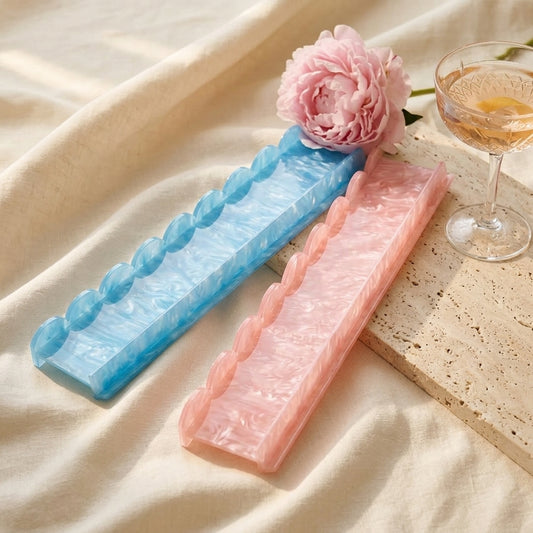
ALOXO Pearl Shell Mahjong Racks with Integrated Pushers
Handcrafted pearl shell finish provides seamless aesthetic harmony for luxury Mahjong gatherings. Sturdy construction and smooth magnetic pusher glide protect fine table finishes while keeping your tile rows impeccably organized.
TIMELESS SHIMMER & ELEGANCE
VIEW PRODUCT DETAILS3. American Mahjong versus Traditional Formats: Terminology and Block Structures
Players transitioning between traditional Asian variants and the modern American format must learn to navigate distinct terminology and structural differences. Traditional formats rely primarily on three-tile sequences and sets, whereas the American game is governed by a dynamic yearly card that demands a wider variety of quantitative combinations. Understanding these differences prevents confusion and ensures smooth integration into competitive club circles.
Terminology and Block Comparison Table
This comparison highlights the primary physical and rules-based differences between premium luxury setups and standard mass-market game offerings.
| Performance Criteria | ALOXO Luxury Acrylic Solution | Mass-Market Plastic Solution |
|---|---|---|
| Tile Weight and Density | Weighted 30 grams per tile; excellent hand balance | Lightweight 12 to 15 grams; prone to sliding and tipping |
| Backing Aesthetic | Iridescent gold and mother-of-pearl layered finish | Plain flat plastic; easily scratched or discolored |
| Engraving Durability | Deep machine-carved grooves with premium color-fill | Surface-printed ink; rubs off and fades after light use |
| Acoustic Dampening | Satisfying clack with reduced table vibration | Sharp, tinny plastic sound that disrupts the home |
| Pusher Integration | Seamless magnetic pushers with elegant alignment | Flimsy wood or metal rods that scratch dining tables |
| Rule Compliance | 100% compliant with National Mah Jongg League standards | Incomplete 144-tile sets missing extra jokers |
| Product Lifespan | Engineered to endure as an heirloom piece for decades | Requires seasonal replacement due to cracking |
| Tactile Feel | Smooth, non-porous resin with polished radiused corners | Rough plastic seams; sharp, unpolished edges |
Hand-Engraved Acrylic vs Printed Bakelite/Plastic
The visual and tactile differences between premium hand-engraved acrylic and mass-market plastic are instantly clear during play. Mass-market printed plastic tiles feature shallow surface-level ink that rubs off after a few months of intense card play. In contrast, premium acrylic sets feature deep machine-engraved grooves filled with vibrant, fade-resistant pigmentation. This level of craftsmanship ensures the tile face remains legible under any lighting, and prevents the tiles from absorbing oils from players fingers over decades of weekly gatherings.
Integrated Acrylic Pushers vs Wood Racks
Traditional wood racks often suffer from sticky pushers, splitting wood grain, and loose brass pins that can scratch fine wood tables. Modern luxury setups feature premium pearl shell racks with integrated magnetic pushers that glide effortlessly along the table mat. The magnetic connection provides satisfying alignment, making it easy to push out tile walls during the play phase without snagging or damaging your table. This modern design adds a clean, coastal aesthetic to your game table, complementing the sophisticated host lifestyle.
For more detailed information on exposure rules and strategies, consult the guide on exposed vs concealed hands mahjong to refine your table performance.
4. Architectural Specifications and Selection of a Premium 160-Tile NMJL Set
Purchasing a premium American Mahjong set requires understanding the exact technical specifications that separate basic gaming equipment from heirloom-quality collections. A complete set must contain 160 tiles to accommodate standard National Mah Jongg League play, providing the necessary variety for all possible hand combinations. This section analyzes the physical metrics and pricing structure of professional-grade equipment.
Master Specifications Table for ALOXO Collections
This master directory outlines the technical dimensions, material composition, and retail value of our luxury tabletop catalog.
| Product Name | Material and Weight | Dimensions | Price and Best Setup |
|---|---|---|---|
| Mother-of-Pearl & Gold | Weighted Acrylic; 30g per tile | 30mm x 23mm x 13mm | $349; Ideal for heirloom gifting |
| Pink Floral Set | High-Density Resin; 28g per tile | 30mm x 22mm x 12mm | $299; Best for social club hosts |
| Pearl Cat Set | Polished Cast Acrylic; 29g per tile | 30mm x 23mm x 12.5mm | $319; Perfect for animal lovers |
| Sorbet Hot Pink | Glossy Filled Resin; 30g per tile | 31mm x 23mm x 13mm | $329; Direct vibrant table styling |
| Pearl Shell Racks | Composite with natural lacquer finish | 18 inches length; standard fit | $149; Elegant rack upgrade |
| Pink Floral Mat | Non-slip rubber back; neoprene top | 33 inches x 33 inches square | $69; Best for noise reduction |
| Custom Mahjong Mat | Reinforced natural rubber; 3mm | 32 inches x 32 inches square | $89; For personalized play spaces |
| Gemstone Dice | Hand-finished natural amethyst; set of 6 | 16mm standard cube | $49; Premium luxury table accessory |
| Floral Travel Bag | Vegan leather; padded canvas lining | 21 inches x 11 inches x 4 inches | $119; Effortless travel comfort |
| Complete Suite | Full catalog combination bundle | Multi-package standard shipping | $599; Ultimate tournament package |
Core Specs Analysis of 160-Tile Sets
A professional American Mahjong set must feature 160 tiles to fully comply with National Mah Jongg League guidelines. This includes the traditional 136 suited tiles, 8 flower tiles, 8 joker tiles, and 8 blank spare tiles. Each tile must measure approximately 30mm x 23mm x 13mm to fit standard racks perfectly. When selecting a set, ensure the tiles weigh at least 28 to 30 grams. This weight prevents tiles from shifting on the table when a player bumps the rack, maintaining a clean and orderly layout during intense rounds.
Budget-Based Consulting for Modern Tables
When selecting accessories for your game space, consider your group frequency and environment. If you host a weekly social club, investing in a complete suite with a noise-reduction mat and pearl shell racks is the best choice. This setup dampens sound, protects tables, and provides a polished, professional atmosphere. For casual players, a standard 160-piece acrylic set and a vegan leather travel bag offer a high-quality, mobile solution for vacation getaways or porch play.
Cost-per-Use Formula for Heirloom Quality
While cheap plastic sets seem economical initially, their printed faces wear down, requiring frequent replacement. A premium hand-engraved acrylic set costing $349 is built to endure for decades. If your group plays twice a month over ten years, the cost is less than $1.50 per session. This heirloom investment ensures your family enjoys a consistent, premium tactile experience that can be passed down to the next generation, retaining its beauty and performance over time.
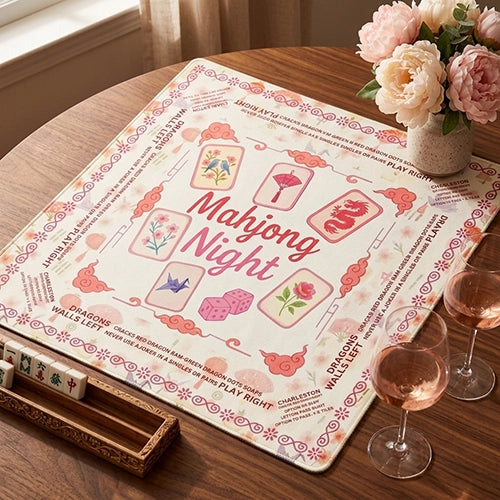
ALOXO Pink Floral Non-Slip Mahjong Mat
Protect cherished tabletop surfaces while reducing tile clatter to an elegant, satisfying murmur. Features non-slip textured backing that lays completely flat straight out of the storage tube without creasing or bunching.
DAMPENS NOISE, ELEVATES STYLE
VIEW PRODUCT DETAILS5. Mastering Joker Rules and Preventing Common Table Pitfalls
Joker tiles provide essential flexibility in building hands, but their placement is governed by strict rules. Understanding where jokers can and cannot be used is key to avoiding dead hands. This section covers common mistakes, hidden traps of cheap sets, and best practices for protecting your luxury acrylic pieces.
Top 5 Fatal Beginner Mistakes
- Using chemical acetone or alcohol-based cleaners on acrylic surfaces, which strips away the lacquer and clouds the material.
- Playing without a protective mat, risking fine scratches to cherished dining room tables and wearing down tile backings.
- Forcing misaligned magnetic pushers, which can chip the natural lacquer finish on wood or pearl shell racks.
- Placing a joker tile in a single or pair combination on the card, which is an illegal move that immediately voids your hand.
- Storing damp or oily tiles in non-breathable cases, causing moisture to degrade the brilliant mother-of-pearl backing.
Hidden Traps of Mass-Market Sets
Many budget listings advertise complete sets but include only 144 tiles, lacking the essential jokers and flowers required for American Mahjong. Others use cheap printed decals that easily peel off, leaving tiles blank and unreadable. Always verify that your set is a genuine 160-tile NMJL-ready package. Choosing a reputable US-registered brand like ALOXO ensures your tiles are fully compliant, durable, and free of manufacturing defects, saving you the frustration of incomplete or damaged shipments.
Tile Care SOP for Cast Acrylic and Mother-of-Pearl
To preserve the brilliant shine and smooth glide of your tiles, follow a simple cleaning routine. Wipe each piece with a dry, clean microfiber cloth after play to remove skin oils. For deeper cleaning, use a damp cloth with mild soap, avoiding harsh chemicals. Store tiles in felt-padded trays inside your carrying case to prevent friction damage during transit. Keeping your set in a climate-controlled room prevents the mother-of-pearl backing from warping, ensuring your heirloom pieces remain beautiful for generations.
To master consecutive runs or complex card structures, consult our guides on understanding nmjl consecutive runs, study the rules for quint hands rules american mahjong, or learn about the like numbers hand mahjong rules to elevate your scoring potential.
Frequently Asked Questions about mahjong tile combinations explained (FAQs)
- What is the main difference between a pung and a kong? - A pung consists of three identical tiles, whereas a kong consists of four identical tiles. Both groups can utilize jokers as substitutes in American Mahjong.
- Can I use a joker to complete a pair on my card? - No, jokers can never be used to complete singles or pairs according to the official rules. They are only allowed in pungs, kongs, quints, and sextets.
- What are the requirements for exposing a quint hand? - A quint requires five identical tiles, meaning at least one joker must be used since there are only four natural identical tiles of each design.
- How do I know if a tile combination can be exposed? - You can only expose a combination if the hand you are building is marked as an exposed hand on the card and you call a tile to complete a group.
- Why does a standard American Mahjong set contain 160 tiles? - The 160 tiles include the traditional 136 suited tiles, 8 flowers, 8 jokers, and 8 spare tiles to meet all ta